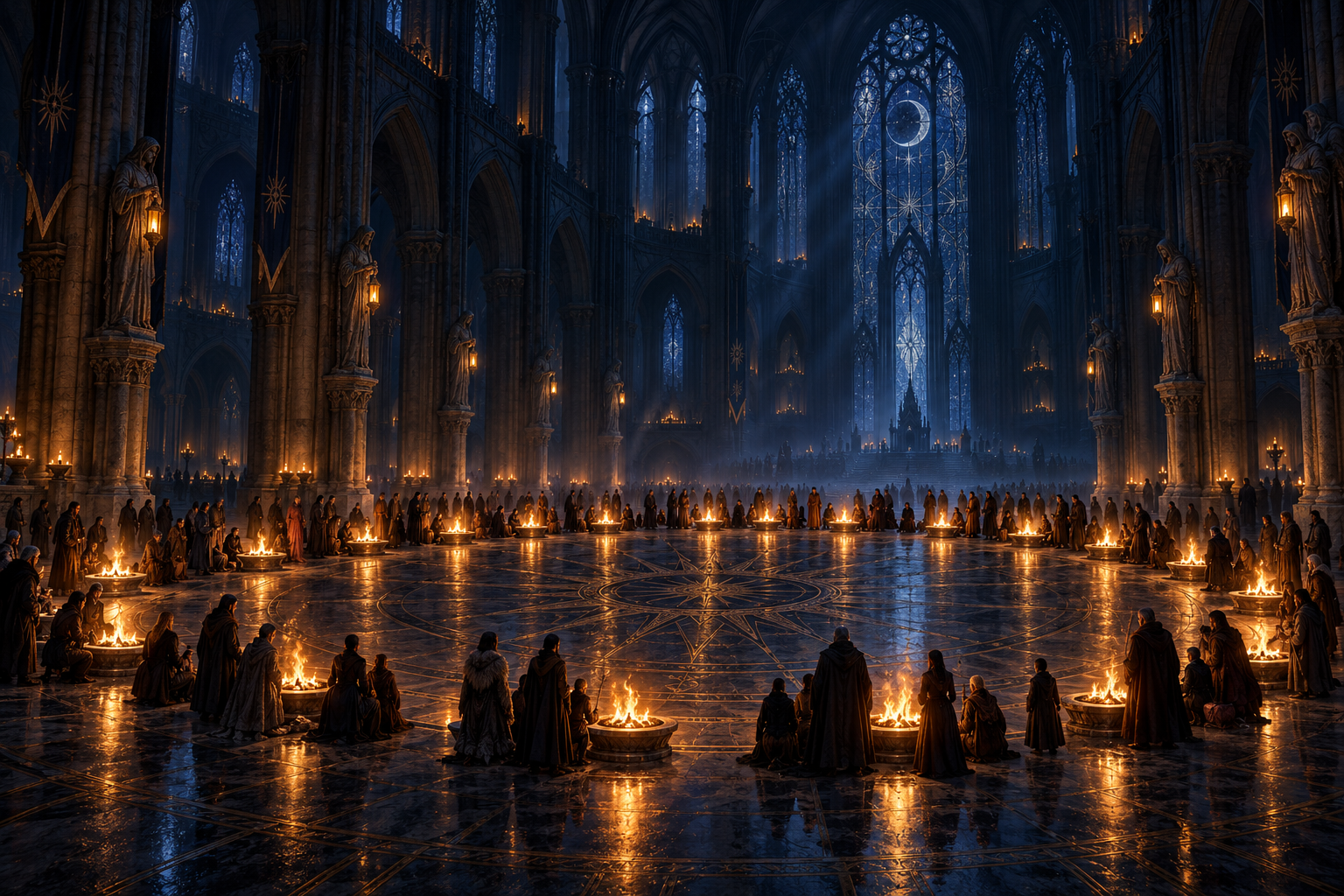
The court did not meet in the winter of the first Long Night. It had met at the counting for a thousand years, and the counting was the empire's; the empire did not do the night. The singing was for the not-doing.
The court met instead at the lanterns, in the winter, the way the village met in the ash, in the water that moved.
The young ones of the Pyre were at the lanterns on the first day of the winter. The rite was not there. It had gone out, on the night of the Blackenings, and the out was the lantern.
They did not wear the white of the tower on the first day. The stone had been white; now it was not, and the not-white was the night the world had not done.
They wore the grey of the road, the grey the scholar had worn on the road for four months with the reading. The ash did not do the grey. The not-doing was the keeping, the keeping the two hundred and thirty had chosen to be.
"The word of the court," the young Archon said to the lanterns on the first day, and the young Archon was not Maethan, because Maethan was in the ash, in the village, in the water that moved. The tower did not do the in-the-water.
The young Archon was what the Pyre had in the tower when Maethan walked out of it on the second night of the Long Night.
"The word of the court is the lantern," the young Archon said. "The lantern is the hand. The hand is not closed. The not-closing is what the singing is for."
"And the singing is what the Hearth-Singers did a thousand years ago. The doing was the burning. The burning was Cressen. Cressen was the two hundred and thirty."
"The two hundred and thirty are the village. The village is the water. The water moves."
The young Archon did not say more.
The court accepted the night on the first day of the winter. The empire had not done the accepting; the not-doing was the counting, and the counting was the thousand years.
And the thousand years were what the Harvest had done. The Harvest was the cup, and the cup was dry, and the dry had gone out, on the fifth night of the Long Night.
The Hearths became the lanterns on the first day of the winter, and the becoming was the six cities: Korath, Veranthe, Thal-Auren, the Grey Quiet, the Vault, and the ash, which was the village the empire did not name.
And the not-naming was the keeping. The keeping was what the two hundred and thirty had chosen to be.
---
Yrren came to the court on the first day of the winter, with the two hundred and thirty. She did not stand at the court: the not-standing was the trade, the rumor, the eleven years on the road, both ways.
She sat at the lantern, with the two hundred and thirty. The doing was the keeping.
And the keeping was the stories, the ones the ash had held for a thousand years, in the ash instead of in the mouth, and that came back changed and small, the way all things kept in the ash come back.
Yrren told the court the old stories on the first day of the winter. The ash did not do the telling. The not-doing was the burning, and the burning was Cressen, and Cressen was the two hundred and thirty.
"The stories are not the empire," she said to the court, at the lantern, on the first day of the winter. "The not-empire is the ash. The ash is the two hundred and thirty. The two hundred and thirty are the village."
"The village is the water. The water moves. The ford did not know about the moving. The not-knowing is what the singing is for."
"And the singing is what the Hearth-Singers did a thousand years ago. The doing was the burning. The burning was Cressen. Cressen was the two hundred and thirty. The two hundred and thirty are the village."
"They are not the empire any more. The not-any-more is the night. The night is what the world did not do. The not-doing is the first of the stars."
The court did not burn the stories on the first day of the winter; the lantern took their place, the hand that was not closed, and the keeping came back, changed, small, in the court of the lanterns, in the city that was not white, under the sky that was the first of the new stars.
And the first of the new stars was the feeding, and the feeding was not the ending.
---
Maethan did not come to the court on the first day of the winter. The not-coming was the water: he was in the village, in the ash, in the water that moved, and the tower had not done the being-in-the-water.
He had walked out of the tower on the second night, with the ash of the heart in the hand that was closed. The closing was the rite, and the rite had gone out, on the night of the Blackenings.
And the out was the lantern, and the lantern was the hand, and the hand was not closed, and the singing was for the not-closing.
He had walked the way the ash walked. The spymasters had not done the ash. The doing was ten thousand years before the counting, and the counting was the empire, and the empire had done the burning, and the burning was Cressen, and Cressen was the two hundred and thirty.
He had walked to the village, and the village was the two hundred and thirty, and the two hundred and thirty were the keeping that the ash did not do, and the not-doing was the heart, and the heart had been ash, on the night of the Blackenings, in the hand of the Archon, at the body of the god, under the city that was not white.
The young Archon did not send for Maethan on the first day of the winter. The not-sending was the lantern: the hand not closed.
The night did not need the rite. The not-needing was the feeding, and the feeding was the first of the stars.
And the first of the stars was the sky, and the sky was the new, and the new was the Orenthe of the lanterns.
And the Orenthe of the lanterns did not die on the first day of the winter, in the court of the lanterns, in the city that was not white, under the sky of the first new stars.
---
In the burning the court is the lantern. The lantern is the hand. The hand is not closed. The not-closing is what the singing is for.
The two hundred and thirty are the village. The village is the water. The water moves. The ford did not know about the moving. The not-knowing is what the singing is for.
The Archon who was is the water. The in-the-water is what the tower did not do. The not-doing was the first of the stars. The stars are the feeding. The feeding is not the ending.
And the not-ending is the Orenthe of the lanterns. The lanterns are the hands. The hands are not closed. The not-closing is the sharing. The sharing is not the ending.
— Dream-Ledger, entry of the first day of the winter of the Long Night, written by Ashe Wren at the court of the lanterns, the index of the two hundred and thirty who were not the empire, and the Archon who was in the water