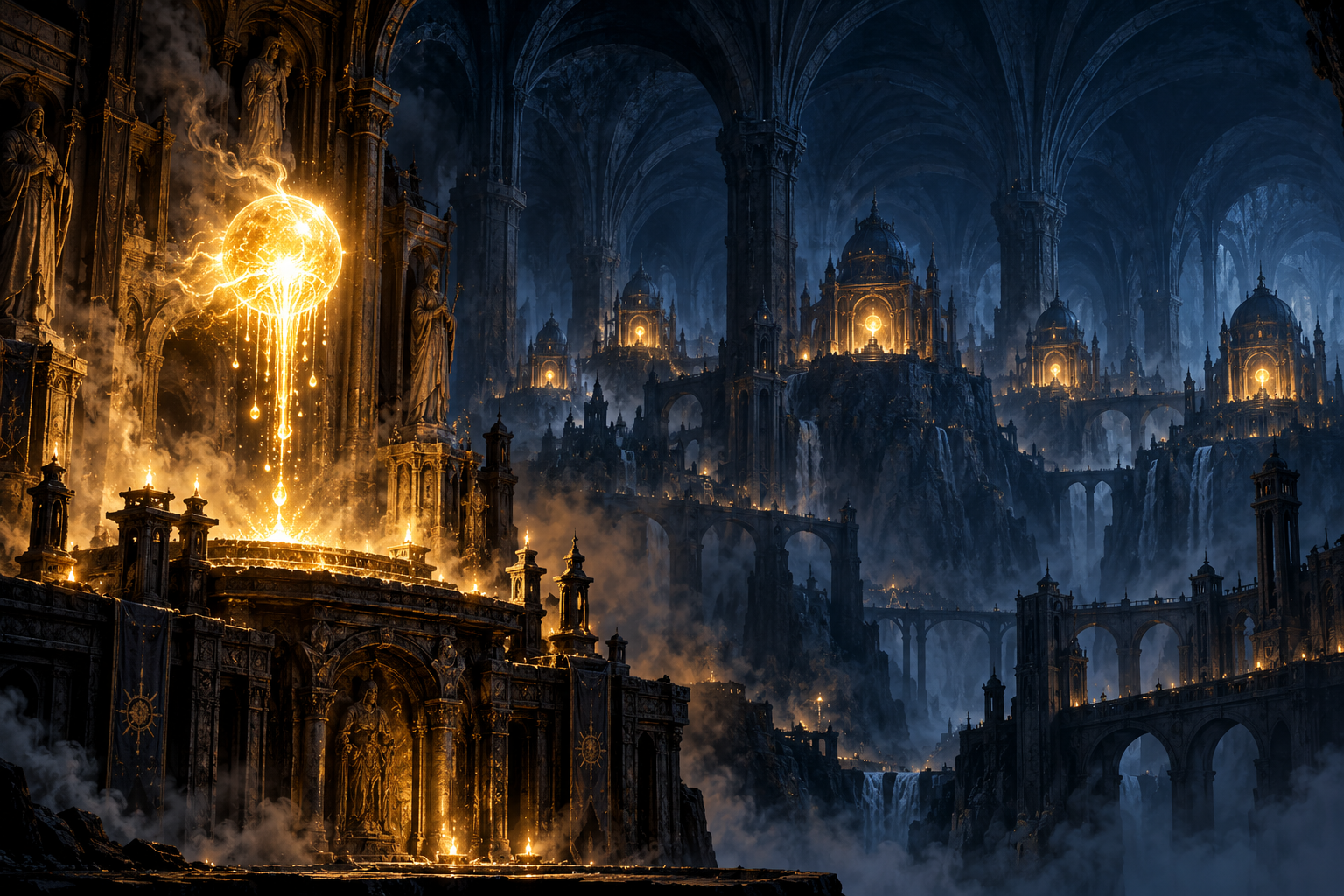
The god was dying by drops, and Orenthe had named the drops grace.
Ashe Wren stood on the archivists' walk above the Sun Vault and watched the Harvest of light through her spyglass, the way you watch a surgeon you have long ago decided is also a butcher. The Vault itself was a cathedral of white stone sunk into the hill above Solmaren's lowest quarter, and on the Harvest-day each of the six great embers was drawn up on rails to the roof like the teeth of a mill, and the light was let off into the empire.
It did not look like killing. That was the cruelty of it. It looked like rain.
The Second Ember, the Heat of Korath, was the biggest and the least ashamed: a pillar of orange, four hundred cubits up into the sky, and around it the collection-towers of the great houses, each one a cupped mouth, each one open. The light that came down was not fire. It was warm, and it ran through Orenthe's veins like the first breath of spring, and it made the forges hot and the grain grow and the fleets sail and the spymasters think. The empire had no other sun. The real sun, the one that moved across the sky, was a pale thing now, a hoarder's coin, dimmed of all the light it had swallowed ten thousand years ago. The people of Orenthe looked up at it the way you look at a coin you have spent.
"Archivist Wren." The voice of Voss the clerk slid up the walk from below. "The High Pyre requests the Vault's account of the day's taking. They have asked for it by name of you, not of the Office."
By name of you. In Solmaren that was a thing said the way you say he has come for you.
Ashe put away the spyglass. Her hands were steady, which she had always taken for competence and now suspected was only the particular steadiness of the person who has already decided how to die and not yet decided whether to.
She had decided, three days ago, in the cold scriptorium where the dream-ledgers lay: she was going to say it, in front of the whole Vault, in front of the Pyre and the House-clerks and the six thousand pilgrims who came to the Harvest because the light was cheap and the god was famous. The dream-ledgers were the archives' private and forbidden book. The Hearth-Singers who had not been burned had left their songs in the margins, and the margins had grown, over a hundred and forty years, into a second scripture:
In the burning I am in pain.
In the burning the cup is lighter by a song.
In the burning the sky is a door and the door is swollen and I am the door.
She had read every word in it, all of them, and the one she had not yet had the courage to read aloud to anyone at all was the first line, which was not a dream at all, which was a signature:
Sing this to the people, so that when the taking comes, there will be someone to sing it back.
---
The Vault on Harvest-day was a sea of white faces. Ashe walked in through the archivists' door and the sea made a channel for her that was not welcome, and Voss the clerk was there, and behind Voss the clerk, in the front row of the pilgrim benches, was a man she had not seen in three years — very tall, very thin, wearing the old grey of the general's staff, cut to fit him. She said his name out loud without deciding to:
"Corvin."
Corvin Mael looked at her. He looked at her the way you look at something on the road that you are going to kick and not kick.
"Archivist," he said. His voice was a door in a room you do not want to enter. "I was told the Office sends one."
"You have been told a great deal." She went up the walk, and the sea followed, because what the sea did not know was that the archivists had a right to read the day's taking to the Pyre, and that the taking was where a woman of twenty-six with ink on her hands was going to say the god is in pain, and that it was a right the sea did not survive to use.
The High Pyre's representative that year was the Archon's daughter, Liora Voss, and Ashe had last seen her at the burning, which was a thing everyone in Solmaren knew, because the burning of the Hearth-Singers at Cressen was two hundred miles from the city and everyone had still watched the road go red for a week. Liora was in the front row in white, her face arranged in the calm of the people who had done the right thing and are now, forever, the people who did the right thing, and when Ashe's mouth opened the girl's hand closed, very slightly, on the back of the bench in front of her.
Ashe read the taking. The numbers went into the record: how much of the Heat, how much of the Growth, how much of the Storm, how much of the Quiet, how much of the Dusk, and how much of the Dawn, which was the smallest of them and the oldest and the one the empire had kept longest, and the one it had, two hundred miles to the south, burned.
And then, because she had decided, and the deciding had been three days and a cold scriptorium and a signature, she said:
"In the burning I am in pain."
The Vault was quiet in the way a bell is quiet after it has been struck.
"In the burning the cup is lighter by a song. The Harvest takes from the body by the dream-ledger. The ledgers are archived and forbidden because the taking does not feed the empire, the taking feeds the dark between the stars, which is what the sun swallowed out of fear, which is the Long Night, which is coming when the cup is dry, and the cup is dry, Archon, because we have been drinking it for a thousand years and calling it grace."
The words of Liora Voss, Archon's daughter, did not come in the order the white-faced people expected. They came in the order of the girl who had, two hundred miles to the south, told a general to burn a village of singers, and who had been, ever since, the calm that is afraid:
"You are charged with the Frenzy. You will be branded and you will walk the road to Mourne and you will not come back to the Vault, and if you are kind to the empire, which you have told the empire you do not love, the empire will be kind to you, which is to say: it will let you live in a city of the second rank, and you will be old, there, and no one will have asked you to sing."
Ashe walked down the walk. The sea closed behind her, closing the way water closes on a stone.
Corvin Mael was not in the Vault when she reached the door, but he was in the road when she reached the street.
The general who had burned Cressen did not let a woman walk out of the capital alone. Not for the love — that was long over. He had been in the village at Cressen. He had given the order. He had walked out of the smoke holding a name, and twenty years had not let him put it down. So he had followed Ashe across three provinces, not for the woman, but for the weight, because the weight walked lighter in a direction.
"Archivist," he said. "The brand is on your left. It will not heal. You will walk the road with me."
"I will walk the road with whoever." She looked at him. "I will not walk it alone, and I will not walk it back."
"I am not asking you to walk it back."
"No." She heard, and was ashamed of the hearing. "You are asking me to walk it forward, into the ash. You are the general who gave the order. I am the woman who read the ledger the order was built on, because the ledger was, at Cressen, a line of numbers, and you are the knife, and I am the hand that held the page, and we are going to walk into the same ash, because the ash is where the song is kept, and the ash is patient."
Corvin did not answer. He walked.
In the road behind them the sea of white came up to the door of the Vault, and Liora Voss, Archon's daughter, was inside it, and her hand, on the back of the bench, was open now, and the palm of it, the whole of it, was wet.
---
In the burning I am in pain, and the pain is not mine. I did not know that a body could be a cup. I did not know that the cup could be held. Now I am the bottom of the cup, and the bottom is cold. The cold is what I was, before the light. The light is what you are, now. You are the last of it, and I am the first of the nothing, and the nothing is coming. In the dream I have asked one thing only: that when the taking comes, there will be someone to sing it back. That is what the song is. That is why it cannot lie. But it is not a song for the empire. The empire is the cup. The song is for the one who was, before the cup, the warmth.
— Dream-Ledger, Vault of Solmaren, final entry in the archivist's hand, the night before the Harvest