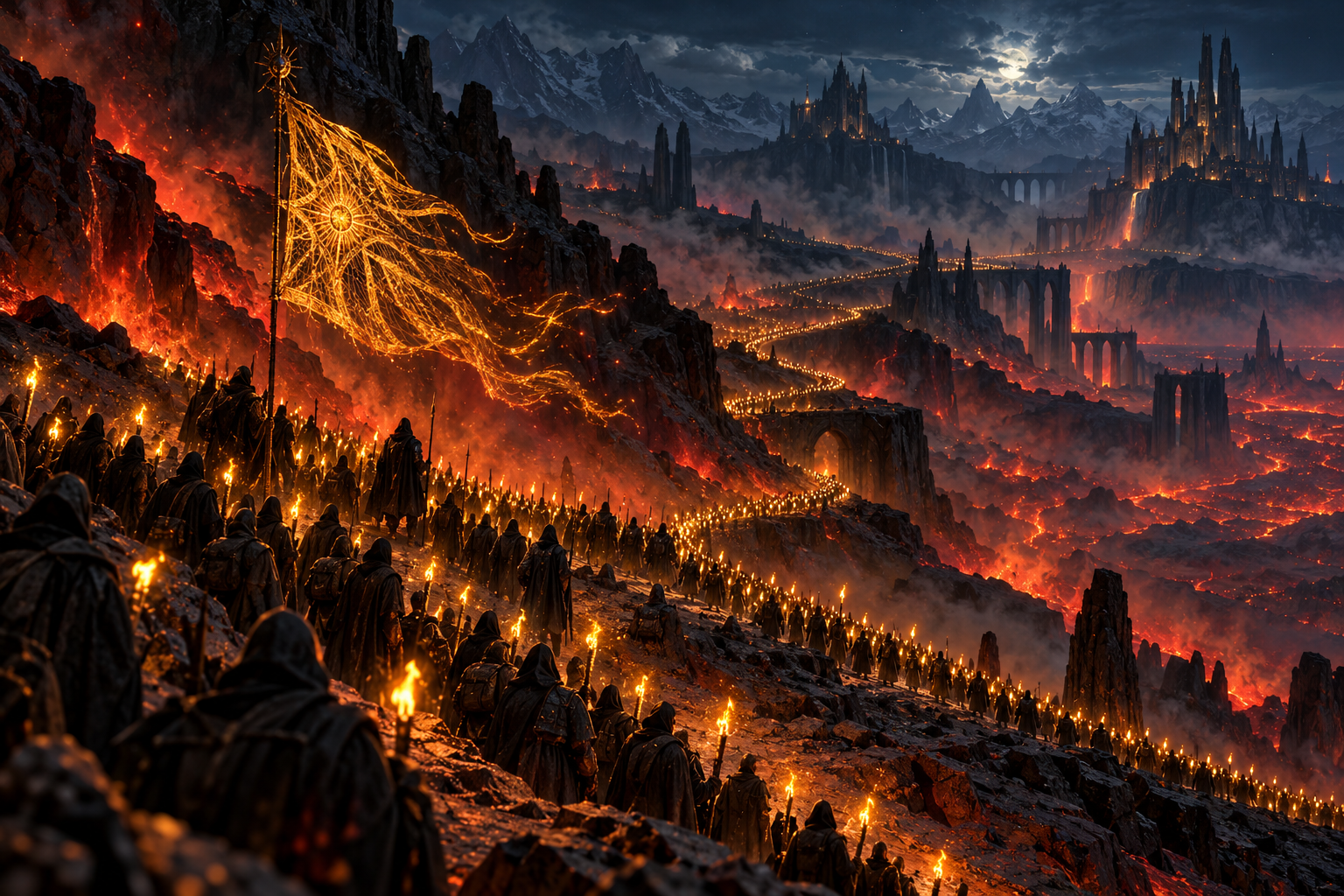
The army came over the passes on the sixtieth day, and it was not the riders.
The Pyre had not sent the word. It had sent the word, and the commander had carried it on the mountain for a hundred days. The closing it carried had been, since the Harvest, the length of the whole plain — until that morning, when the plain was on the other side of the mountain.
Two thousand men came over the passes. The ash had not seen such a thing since the Fall. The two hundred and thirty were the ash; they kept the ember, and the keeping is what a thing is not seen for.
They came with the Six Houses' seals on the banners, and the seals fed the Harvest, and the Harvest had gone dry. The two thousand carried that dry light up the mountain the word had closed, and the closing was open now.
The commander of the two thousand was not the commander of the riders. The High Pyre had named him Vaerun, and his banner flew over the army.
"Walk the ember," Vaerun said to the village, on the second day, when the two thousand had camped on the ash. "The Pyre has set the rite, and the rite needs the six. The six are the ember, the ember is the cistern, and the cistern is empty. Walk it to the Pyre."
"You know the cistern is empty," Ashe said to Vaerun, in the camp. "The ledgers say so, and the burning did not do the ledgers."
"The Pyre knows," Vaerun said. "It knows everything the six know, and the rite needs that knowing. The rite is the Blackenings, four months away. Reaching it is the walking, and the four of you in the camp are where the two thousand are."
Pellin, the fourth, stood at the far side of the camp's fire, the way the scholars stood. On the second night he wrote, in the tent the Pyre had given him.
He wrote the letter the way the reading did: with the index, with the ledgers, with the one thing the burning did not do.
The First Ember is not in the cistern of Mourne-ash. The keeper walked it out on the night of the taking. The three are: the Frenzied, the General, and the Child of the Trade. The fourth is a scholar of the Office, and the scholar is the far side of the fire. The ember, if it is to be taken, will be taken by the four. The camp does not know about the four. The Pyre does, and the knowing is this letter.
The letter went up the mountain on the fourth day, in the hands of the riders the commander had left on the word.
The Pyre read it in the capital, in the tower of the High Pyre, and the seal that carried it up the mountain was the same seal that had named Vaerun over the two thousand.
"What the letter does not say," the Pyre said to the seal, "is where the road is going. The road is the four, on the other side of the mountain, the side the word did not close. The ford does not know about that side."
"The ford moves," the seal said. "The snow was lighter this year, and the riders watched it in the plain. The camp is the cup, and the cup is dry now."
"Then we do not watch the ford," the Pyre said. "We walk the road. The road is the four. The camp does not know about the four, but the Pyre does, and the knowing is the letter."
The Pyre did not say the name of the four's destination. The letter did not say it, and the Pyre would not, in the tower, with the hand not closed.
The destination was the Pass of Cinders, the road the four were walking and the two thousand were not.
---
The four left the village on the sixth day. The two hundred and thirty kept the ember from falling on the ash, and the keeping was what made the leaving possible.
Serath did not walk. The old man had chosen the not-walking since the Fall, and the choosing was the length of the sky, longer than the mountain.
"You will walk it out," he said to Ashe, at the gate of the village, where the gate was not a thing the village had. "The ember is in your hands, and your hands are not closed. Not-closing is the road, and the road is the Pass of Cinders."
"You are not coming," Ashe said.
"I am the village," Serath said. "The village is the two hundred and thirty. They keep, and the keeping is what the ember did not fall on. The falling-on was the Fall, ten thousand years before the counting."
He put his hand on the ember. The hand was not closed.
"The singing is for the one who was, before the cup, the warmth," he said. "The warmth is the ember, and the ember is what you are carrying. The carrying is the four months, and the four months are what the rite needs."
They walked. Serath watched them go. The watching had been, since the Fall, the length of the whole sky, and the sky over the village was not hoarded.
---
In the burning the old man is the village, and the village is the two hundred and thirty, and the two hundred and thirty are the keeping, and the keeping is what the ash did not do. The not-doing is what the ember did not fall on, and the falling-on was the Fall. The Fall was ten thousand years before the counting, and the counting was the empire, and the empire did the burning, and the burning was Cressen, and Cressen was the two hundred and thirty, and the two hundred and thirty are the village, and the village is the old man. And the old man did not walk.
— Dream-Ledger, entry of the morning they left Mourne-ash, written by Ashe Wren, the index of Serath, who stayed