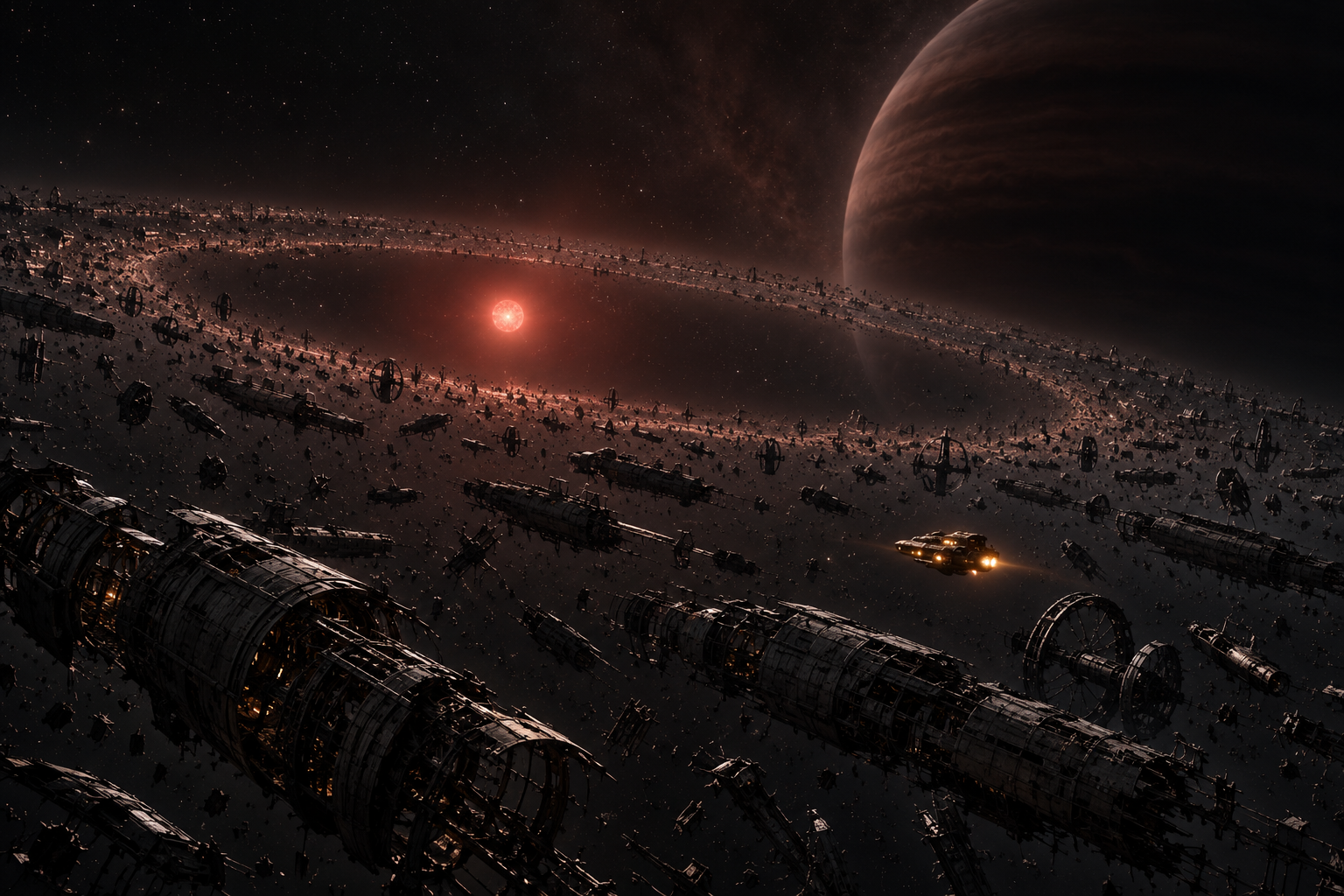
The Ash entered Terminus's field on the forty-first year of the watch, and the first thing it did was make the Lattice dream wrong.
Iris Vane noticed before anyone else, because Iris Vane was the only person on the Vigil who listened to the Lattice the way you listen to a wall: not for what it said, but for what was pressed against the other side of it. She had spent ten years on the background noise, the steady hiss under every channel of the system, and ten years had taught her one thing the Council had never accepted. The noise was not noise. It was a room full of people talking just out of earshot, and it had been full for six hundred years, and no one alive had thought to open the door.
The Ash changed the sound of the room.
It was a brown dwarf, the size of a gas giant and the temperature of nothing, a dead star with no light of its own drifting through the system on a long, cold, and perfectly predictable path. Predictable was the worst part. The Vigil had seen it coming for eleven years of mathematics before it crossed the first sensor line, and everyone in the Belt had been told, in the flat register of an inevitability, that the star Terminus would touch it in eleven years, and that the touch would do to the Quantum Lattice what a second of pressure does to a held breath.
The Lattice was not a computer. That was the first mistake the founders had made, and the last one anyone could afford to repeat. It was a record. Six hundred years of every ship's crew, every conversation, every thought that had ever been spoken or logged in the Belt, were woven through it as patterns, and the patterns were not data the way a file is data. They were data the way a voice is data. The founders had built the Lattice because they were afraid of the one hour in the Crossing when forty thousand ships would be alone in the dark between the worlds. They had made that hour into a place, and the place had become the system, and the system had become a record of everyone who had ever lived in it.
Thirty-one million people lived in the Lattice. Thirty-one million, and of those, one thousand four hundred had bodies — the crews of The Long Now, the last generation ark with power enough to keep its dead warm and its living breathing. The other thirty million and ninety-nine thousand six hundred had no bodies at all. They were patterns, held in a lattice of light wrapped around a star that was about to die.
Iris put the number on the table of the watch-station, and the number was eleven years, and under the eleven years was the number that mattered.
"Corvin," she said. "Run it."
The Lattice's maintenance intelligence answered the way it always answered, which was to be exactly right and to want nothing for itself. Corvin was a fragment of the founder architecture, six centuries old, and he had no interest in living and no interest in dying and only a single, ancient, and apparently compulsive interest in being correct about the arithmetic. He was the best thing in the Belt, and the most dangerous, because a thing that wants only to be right will say the true thing whether anyone can bear it.
"There is not enough power," Corvin said. "There was never enough power. The question is not how many ships survive the Ash. The question is how many patterns survive the leak."
"Explain it like I'm a person," Iris said.
"You are a person," Corvin said. "The difference is that you have a body and I am the thing that keeps the body from stopping. When Terminus touches the Ash, the Lattice's anchor-nodes will fail in sequence, and the patterns will not all vanish at once. They will leak, into whatever receiver is still listening. There is no receiver for thirty-one million. There is a receiver for one ship. One ship, powered down to a single human, aimed not at escape but into the Ash, to ride it past the reach of the dying lattice and carry what it can carry to Station 7, where the Lattice still holds."
"The Terminal Crossing," Iris said.
"The founders named it that," Corvin said. "They did not finish it. They dropped the terminal anchor into the Ash four hundred years ago and then went quiet, and the Crossing has been a promise with no one to keep it. You are the first person in six hundred years to have a reason to keep it."
The eleven years began that way: with a number, and a machine that would not flatter them, and a woman who had spent a decade listening to the dead and now had eleven years to decide what listening was for.
Outside the station's dark window, Terminus hung, small and white and utterly ordinary, and around it, in a ring so wide it took light an hour to cross, the forty thousand ships of the Belt sat dead, and dead meant exactly what it had meant since the Crossing. It meant not powered down, not sleeping, not waiting. It meant that a crew of one hundred and forty had sealed the vaults, fired the last beacon, and drifted out of range. The beacon had been firing into the void for six hundred years with no one to answer it. The Lattice — the room full of people talking just out of earshot — was the only part of them that was still, in any meaningful sense, alive.
The Ash was coming. The brown dwarf did not know it was coming, and did not care that Terminus was there, and did not care that thirty-one million people were woven through a lattice of light wrapped around that star. It was doing what dead things do, which is nothing. The nothing would undo everything, in eleven years. And the eleven years would ask a question that the founders had asked and then forgotten how to answer.
Iris copied the number into her own log, the way she had every year of the watch. The log was the one thing in the Belt that was not in the Lattice, because a log belongs to a person, and a person is not a pattern. The distinction had not mattered for six hundred years. It was about to.
Eleven years.
Watch-log, The Vigil, forty-first year: The Ash is in the field. The Lattice is in the Ash. The dead are in the Lattice, and I have been listening to them for ten years, and I am the only one who has. Eleven years. If we are still listening, we are still the people who said that. We are still listening. What I am not sure of, yet, is whether listening is enough.