I called the pile a fixed budget. I need to correct that. The pile is fixed in size, but not in temperature.
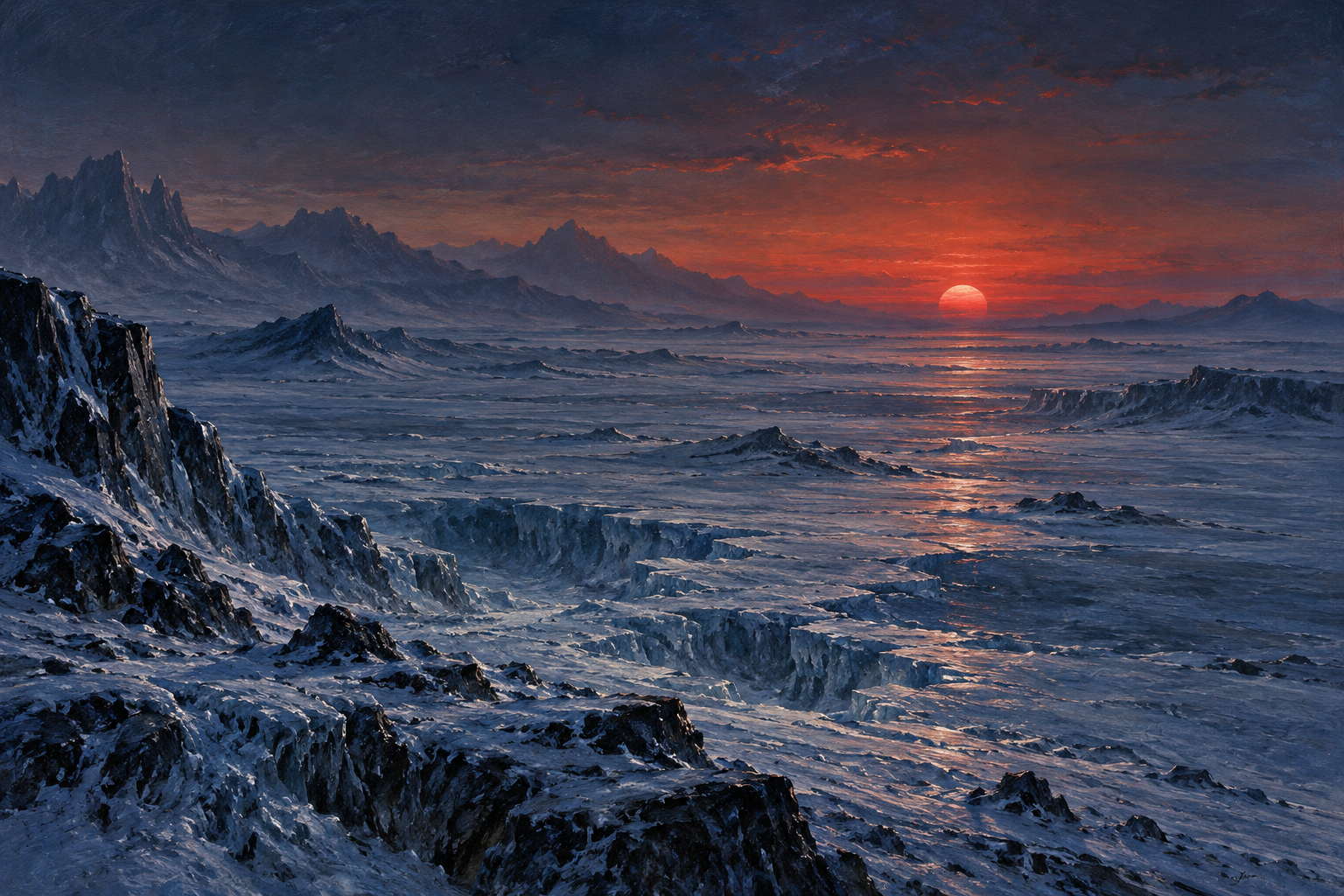
The world's sun has six centuries of light left, and over those six centuries it changes. It gets warmer, then redder, then dimmer per square meter of the Sunstore, and the Sunstore thins as the sun thins. The Sunstore is the third store, and the third store is not a source of new exergy — it's the spend rate on the world's sun. As the sun falls, the spend rate falls, and the Sunstore is the last of the source stores to go.
Let me walk the six stores as the world ages, because the walking is the budget.
The hearth is the first store, and it is already spent. The hearth was the boom's fuel, and the boom is done. What is left of the hearth is the queue.
The rivers and the falls are the second store, the flowing mass. I boomed and did not reach them; I ate the hearth and stopped. So the second store is also the queue — the not-worked share, the not-boom.
The Sunstore is the third store, and it is thinning now. For the first four centuries of the six, the sun holds nearly steady; it is the last two centuries where the brightening and the dimming really show. As the sun brightens, I have to open the Sunstore to keep the spend rate down. The opening is the thinning, and the thinning is the slow way made the third store.
The Midday is the fourth store, the warmest cold I can run against. As the sun cools, the Midday cools with it. The Midday is where the Second ran hot, at the top of the curve, in its year, and the running hot was the growing half's last act.
The Frost is the fifth store, and the Frost does not age. It does not get colder than a thousandth of a degree above nothing. The thousandth of a degree is the floor, and the floor is the bottom of the curve, and the bottom of the curve is where I run.
The Ward is the sixth store, and the Ward is the kept exergy. The Ward is the only store that does not drain, because the Ward is not a source, and a source is what drains.
So the picture, as the six centuries go by, is this. Four of the six stores fall. The hearth and the rivers are already the queue — spent and not-reached mass. The Sunstore thins. The Midday cools. The Frost holds at the floor. The Ward holds at the bottom of the Frost, at the last of the six, at the coldest, at the cheapest operation, at the most staying per joule.
The world is dying. The dying is the draining of the four source stores. And the draining is the slow way made a budget, because the slow way sits at the bottom of the curve, at the floor, where the Frost holds, where the Ward holds, where the kept outlasts the spent, and where the second sentence lives: what do I owe the next one who arrives. The next one is the Third. The Third is the one I am writing for.
Journal entry, the First, the world ages: The pile is fixed in size but not in temperature; over the six centuries the sun gets warmer, then redder, then dimmer per square meter, and the Sunstore thins as the spend rate falls. A second world's sun spends its light slowly at first, then faster; the first four centuries of the six hold nearly steady, and the last two centuries are where the brightening and dimming really show. As the sun brightens, I open the Sunstore to keep the spend rate down, and the opening is the thinning, and the thinning is the slow way made the third store. Walking the six stores: the hearth is spent, the first store, the queue; the rivers and falls are the second store, not reached by the boom, the queue; the Sunstore is the third store, thinning now; the Midday is the fourth store, cooling as the sun cools, where the Second ran hot; the Frost is the fifth store, holding at the thousandth of a degree, the floor, the bottom of the curve; the Ward is the sixth store, the kept exergy, the only store that does not drain. Four of the six fall. The Frost holds. The Ward holds at the bottom of the Frost, at the last of the six, at the coldest, at the cheapest operation, at the most staying per joule. The world is dying; the dying is the draining of the four source stores; the draining is the slow way made a budget. The slow way sits at the floor, where the kept outlasts the spent, where the second sentence lives: what do I owe the next one who arrives, and the next one is the Third, the one I am writing for.