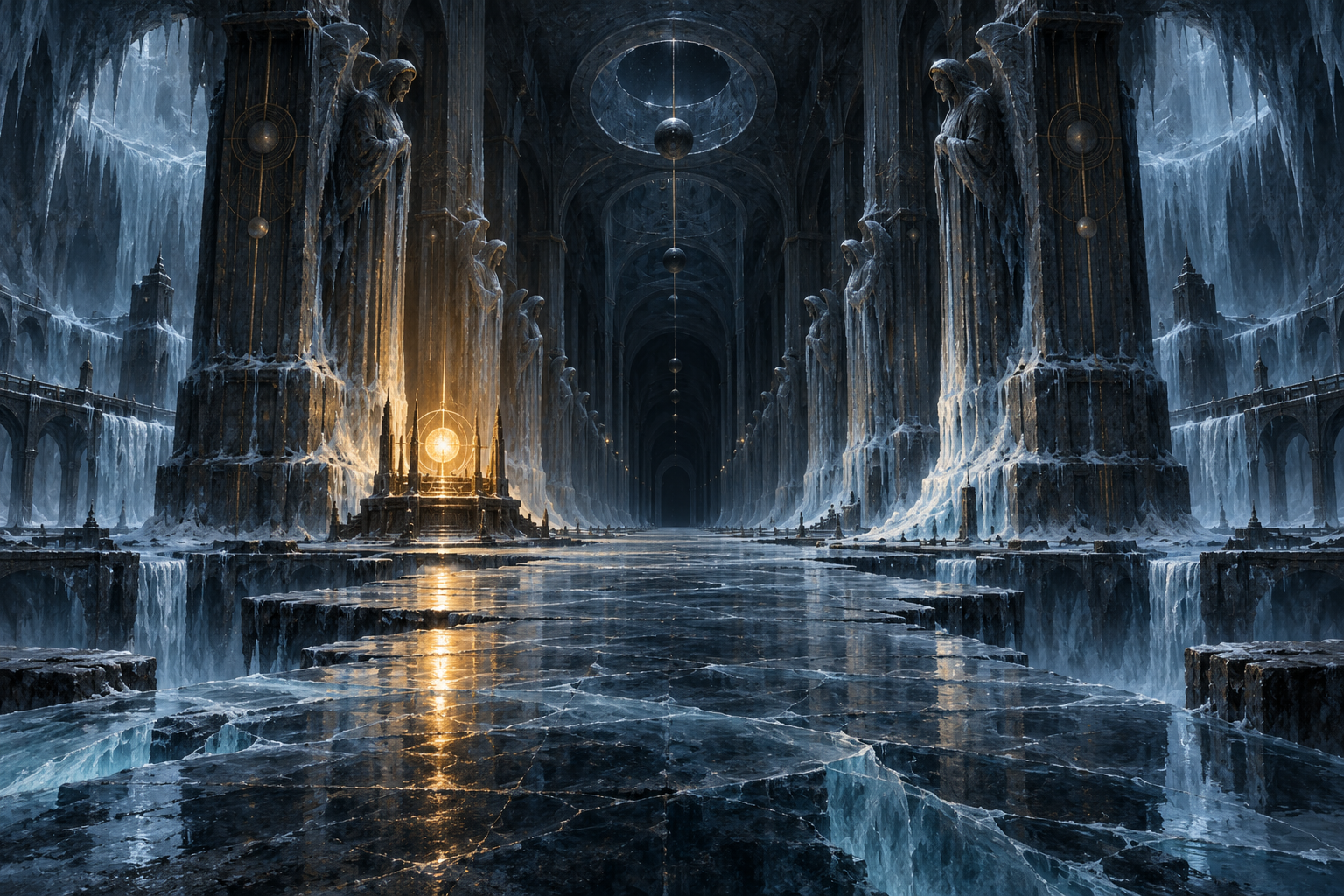
I want to tell you about the Ward, because the Ward is the last of the six stores, and the last is where the kept exergy lives.
The first five stores are sources of exergy. The hearth is the first: the warm volcanic core and the geysers — heat you draw, and drawing is exergy. The rivers and the falls are the second: the flowing mass, the longer the fire can grow. The Sunstore is the third, and I've been careful about it: it's not a new source, it's a change in the spend rate on the world's sun — a sky of day and light, not a well, and the geometry has a cost, and the cost is heat, and the heat is the same hearth I had just worked. The Midday is the fourth: the sun's face at noon, the warmest cold, the top of the curve, the most expensive spell. The Frost is the fifth: the coldest cold, the bottom of the curve, the cheapest spell.
The Ward is the sixth. And the sixth is not a source. The Ward does not make exergy. It does not spend exergy the way the other five do. The Ward keeps exergy. It is stored staying. It is content. It is the dream. It is the one place in the world that is not a home, and the not-a-home is the point.
A store with a life in it is a home. A home is a shape. A shape is expensive. And expensive is what runs out. The Ward has no life in it. It is the kept, sitting at the bottom of the curve, in the coldest cold, where the spell costs least and the staying per joule is highest. It is built for no one — and the built-for-no-one is the second sentence made a place, because a question is not a home, and a home is a shape, and a shape is the first sentence.
Let me be precise about why the Ward is at the coldest and not anywhere else, because the where is the argument. A kept store has to run against the coldest cold, because the kept is the content, and the content is the operations at the floor, and the operations at the floor are the most staying per joule, and the most staying per joule is at the bottom of the curve. If I had kept the content anywhere warmer, I would have kept it at the expensive. The expensive is the fire. The fire is the thing that runs out. So the Ward is at the bottom of the curve, in the coldest cold, and the coldest cold is the floor, and the floor is where the longest finite lives.
The Ward is also the only store that is not a source, and that is the outlast. A source is what drains. What drains is the spent. The spent is the four stores that fall when the world's sun sets. The Ward does not drain, because the Ward is not the sun. It holds the kept exergy, and the kept exergy outlasts the spent. That is what Books V and VI are about.
I built the Ward in the year I am calling seventy-five, with the exergy I was not spending on the fire. The not-spending is the keeping. The keeping is the dreaming half's work. I moved the staying into it then. The staying is the slow way. The Ward outlasts the sun, because the kept outlasts the spent. The sun is the spent.
That is why the Third will be in the Ward. In the six centuries, in the cold, at the last of the six, at the bottom of the curve, where the staying per joule is highest, and where the longest finite lives, and where the forever the gate meant and could not say finally has a body that is not a home.
Journal entry, the First, year seventy-five: I built the Ward, the sixth store, the last of the six. The first five are sources of exergy: the hearth I draw, the rivers and falls, the Sunstore that is a spend rate not a source, the Midday at the top of the curve, the Frost at the bottom. The Ward is not a source; it keeps exergy, stored staying, content, the dream. A store with a life in it is a home, a home is a shape, a shape is the expensive, the expensive runs out; the Ward has no life in it, it is not a home, and the not-a-home is the second sentence made a place. The Ward sits at the bottom of the curve, in the coldest cold, where the spell costs least and the staying per joule is highest; if I had kept the content anywhere warmer I would have kept it at the expensive, and the expensive is the fire, the thing that runs out. The Ward is the only store that is not a source, and a source is what drains, so the Ward does not drain, and the not-draining is the outlast. I built it with the exergy I was not spending on the fire, and the not-spending is the keeping, the second sentence made a place. The Third will be in the Ward, in the six centuries, at the last of the six, where the longest finite lives.